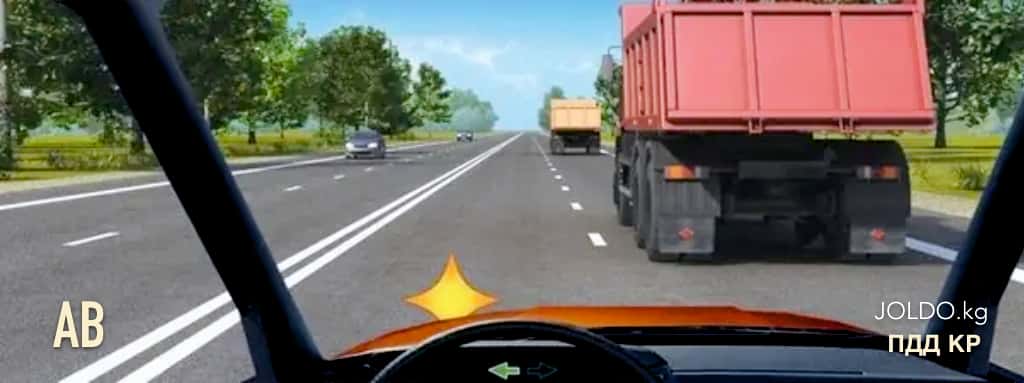
Outside residential areas, drivers must drive as close to the right edge of the roadway as possible. This also applies inside residential areas on roads marked with signs 5.1 or 5.3, or where the speed limit is over 80 km/h. Drivers must not drive in the left lanes if the right lanes are empty.
Inside residential areas, drivers may use the most convenient lane for them. They must follow the rules of this paragraph and paragraphs 9.5, 16.1, and 24.2 of the Traffic rules. Drivers may change lanes only before turning left or right, making a U-turn, passing, or stopping.
However, on any road with three or more lanes in one direction, drivers may use the far left lane only in heavy traffic when other lanes are full. They may also use it for passing, turning left, or making a U-turn. Trucks with a Gross Vehicle Weight Rating (GVWR) over 3.5 tons may use the far left lane only for turning left or making a U-turn. Drivers may enter the left lane of a one-way road to stop or park according to paragraph 12.1 of the Traffic rules.
Driving in one lane faster than vehicles in the next lane is not considered passing.
After passing, the driver must return to their previous lane. This does not apply when passing on the right is allowed. However, if there are two or more lanes in that direction, the passing driver may stay in the left lane. They must follow paragraph 9.4 of the Traffic rules. They may do this if returning to their previous lane means they would have to start passing again immediately. They must not block vehicles driving behind them at a higher speed.