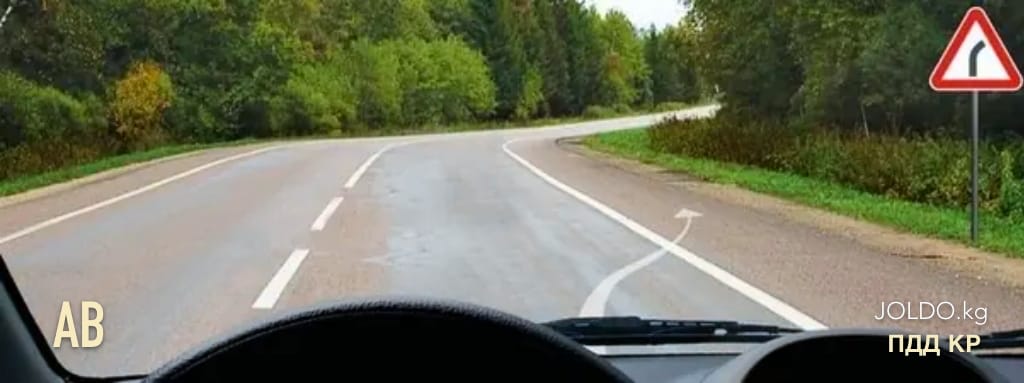
Stopping and parking are allowed on the right side of the road on the shoulder. If there is no shoulder, drivers may stop or park at the edge of the roadway.
Stopping and parking on the left side of the road are allowed inside residential areas on roads with one lane for each direction and no tram tracks in the middle. It is also allowed on one-way roads. Trucks with a Gross Vehicle Weight Rating (GVWR) over 3.5 tons may stop on the left side of one-way roads only to load or unload cargo.
Stopping and parking are banned:
- On tram tracks, and very close to them if it blocks trams;
- At railroad crossings and in tunnels;
- On overpasses and bridges (if there are fewer than three lanes in that direction), and under them;
- In places where the distance between the solid line (except the edge line) and the stopped vehicle is less than 3 meters;
- On crosswalks and closer than 5 meters before them;
- On the roadway near sharp curves and hillcrests if the driver can see less than 100 meters of the road in at least one direction;
- At intersections and closer than 5 meters from the edge of the crossing roadway. The only exception is the side opposite the side street at T-intersections that have a solid line or a median;
- Closer than 15 meters from boarding platforms. If there is no platform, closer than 15 meters from the public transit vehicle or taxi stop sign, if it blocks their movement;
- In places where the vehicle hides traffic lights or traffic signs from other drivers. In places where it makes it impossible for other vehicles to move (enter or exit), or blocks pedestrians;
- On pedestrian refuge islands on streets and roads. This does not apply to police and special service vehicles doing their official duties.
Parking is banned:
- Outside residential areas on the roadway of roads marked with sign 2.1 (Priority road);
- Closer than 50 meters from railroad crossings.