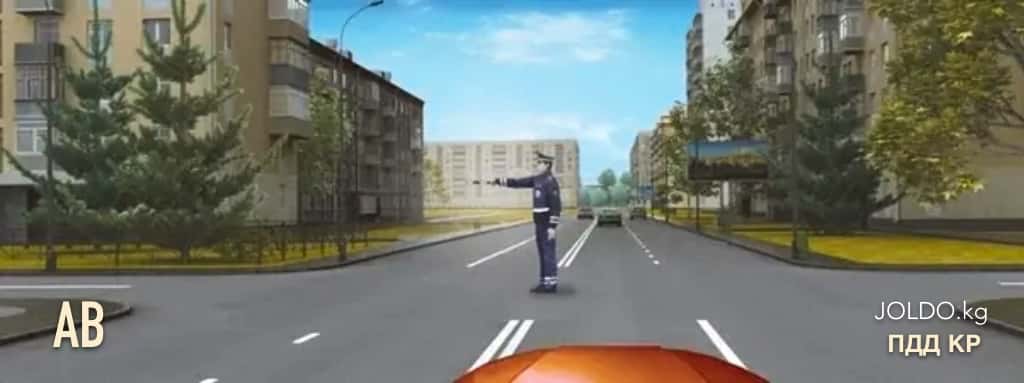
Traffic officer signals mean the following:
- Arms extended to the sides or lowered:
- From the left and right sides: Trams may drive straight. Other vehicles may drive straight and turn right. Pedestrians may cross the roadway;
- From the front (chest) and back: All vehicles and pedestrians must stop.
Right arm extended forward:
- From the left side: Trams may turn left. Other vehicles may drive in all directions;
- From the front (chest): All vehicles may only turn right;
- From the right side and back: All vehicles must stop;
- Pedestrians may cross the roadway behind the traffic officer's back.
Arm raised straight up:
- All vehicles and pedestrians must stop and not move in any direction. This does not apply to cases described in paragraph 6.14 of the Traffic rules.
- The traffic officer may use other hand signals that drivers and pedestrians can understand.
To make signals easier to see, the traffic officer may use a baton or a disk with a red reflector.
Before turning right, turning left, or making a U-turn, the driver must move to the far left or far right side of the roadway for their direction of traffic in advance. This rule does not apply when entering a traffic circle marked with sign 4.3 along with sign 2.4 or 2.5. In this case, the driver must yield the right-of-way to vehicles already driving in the traffic circle.
If there are tram tracks on the left going in the same direction and at the same level as the roadway, the driver must turn left or make a U-turn from the tracks. This applies unless traffic signs 5.15.1 or 5.15.2 show a different rule. The driver must not block the tram when doing this.